
















Connecting to Data from Code
Our sample projects and report templates can help you learn the basics of working with our products.This example shows how to connect to data from code. First, load scripts:
Next, add buttons:
Then, add report viewer:
After that, create empty report object and load report template:
Next, set first dataset:
Then, set second dataset:
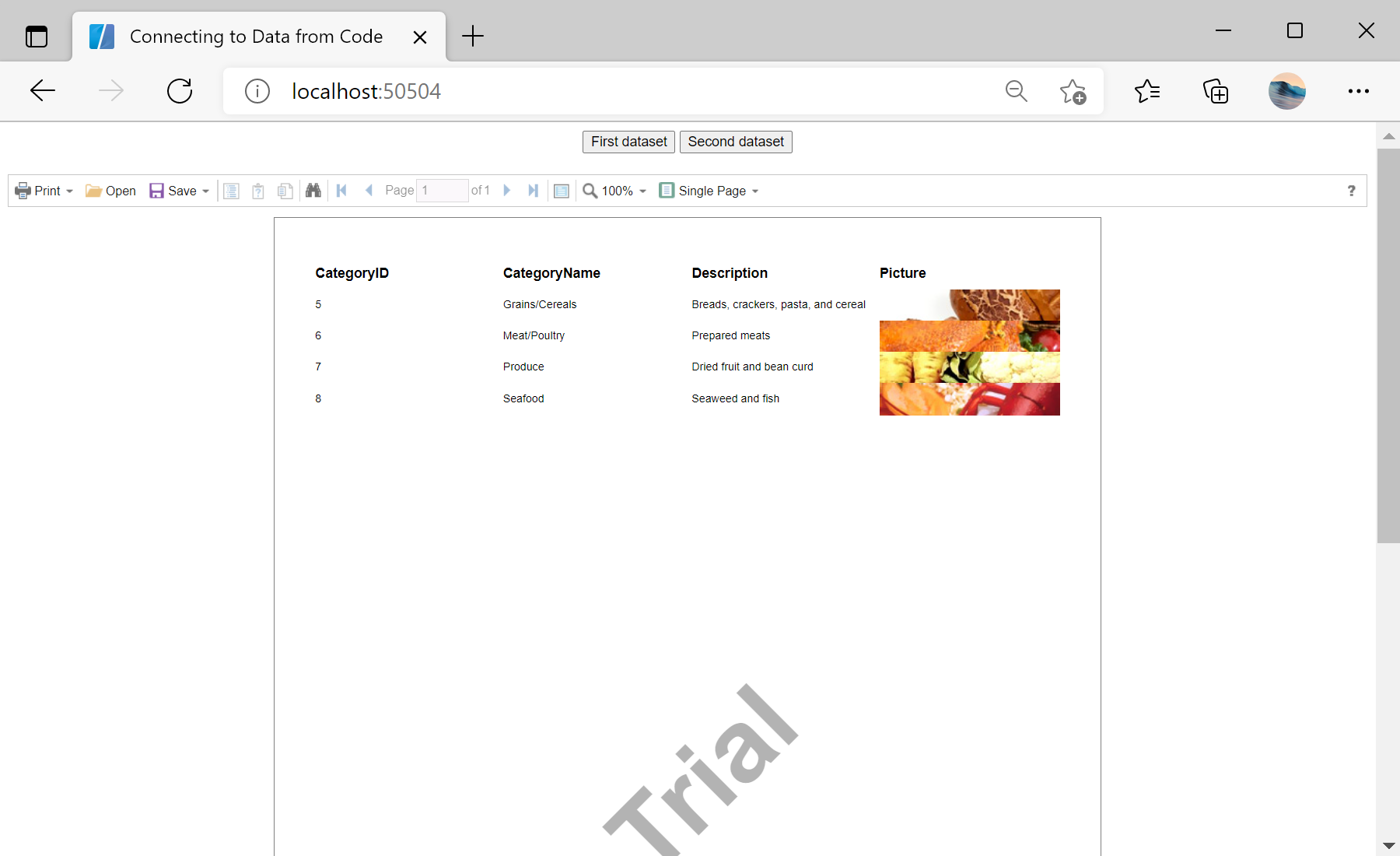
In the screenshot below you can see the result of the sample code:
@using Stimulsoft.Base
@using Stimulsoft.Report
@using Stimulsoft.Report.Blazor
Next, add buttons:
<div align="center">
<button class="alert" @onclick="SetFirstDataSet">First dataset</button>
<button class="alert" @onclick="SetSecondDataSet">Second dataset</button>
</div>
<br />
Then, add report viewer:
<StiBlazorViewer Report="@Report" />
After that, create empty report object and load report template:
@code
{
private StiReport Report;
protected override void OnInitialized()
{
base.OnInitialized();
//Create empty report object
var report = new StiReport();
//Load report template
report.Load("Reports/Report.mrt");
}
...
Next, set first dataset:
...
private void SetFirstDataSet()
{
//Get a copy of the report into a new report object
var report = this.Report.Clone() as StiReport;
//Delete connections in the report template
report.Dictionary.Databases.Clear();
//Load new data from XML file
var data = new System.Data.DataSet();
data.ReadXml("Data/Demo1.xml");
//Register new data in the report template
report.RegData(data);
//Synchronize the dictionary with registered data
//Not necessary if the structure of the loaded data is the same as in the template
report.Dictionary.Synchronize();
//Re-render report
report.Render();
//Assign new report to the Viewer
this.Report = report;
}
...
Then, set second dataset:
...
private void SetSecondDataSet()
{
//Get a copy of the report into a new report object
var report = this.Report.Clone() as StiReport;
//Delete connections in the report template
report.Dictionary.Databases.Clear();
//Load new data from XML file
var data = new System.Data.DataSet();
data.ReadXml("Data/Demo2.xml");
//Register new data in the report
report.RegData(data);
//Synchronize the dictionary with registered data
//Not necessary if the structure of the loaded data is the same as in the template
report.Dictionary.Synchronize();
//Re-render report
report.Render();
//Assign new report to the Viewer
this.Report = report;
}
}In the screenshot below you can see the result of the sample code:
