




















Creating Dashboard at Runtime
Our sample projects and report templates can help you learn the basics of working with our products.A dashboard can be built entirely in code — table elements, dimension columns and filters — without a designed template.
Register data and add elements.
How it works. Building the element tree in code is equivalent to designing it visually, so the dashboard renders identically to a template-based one.
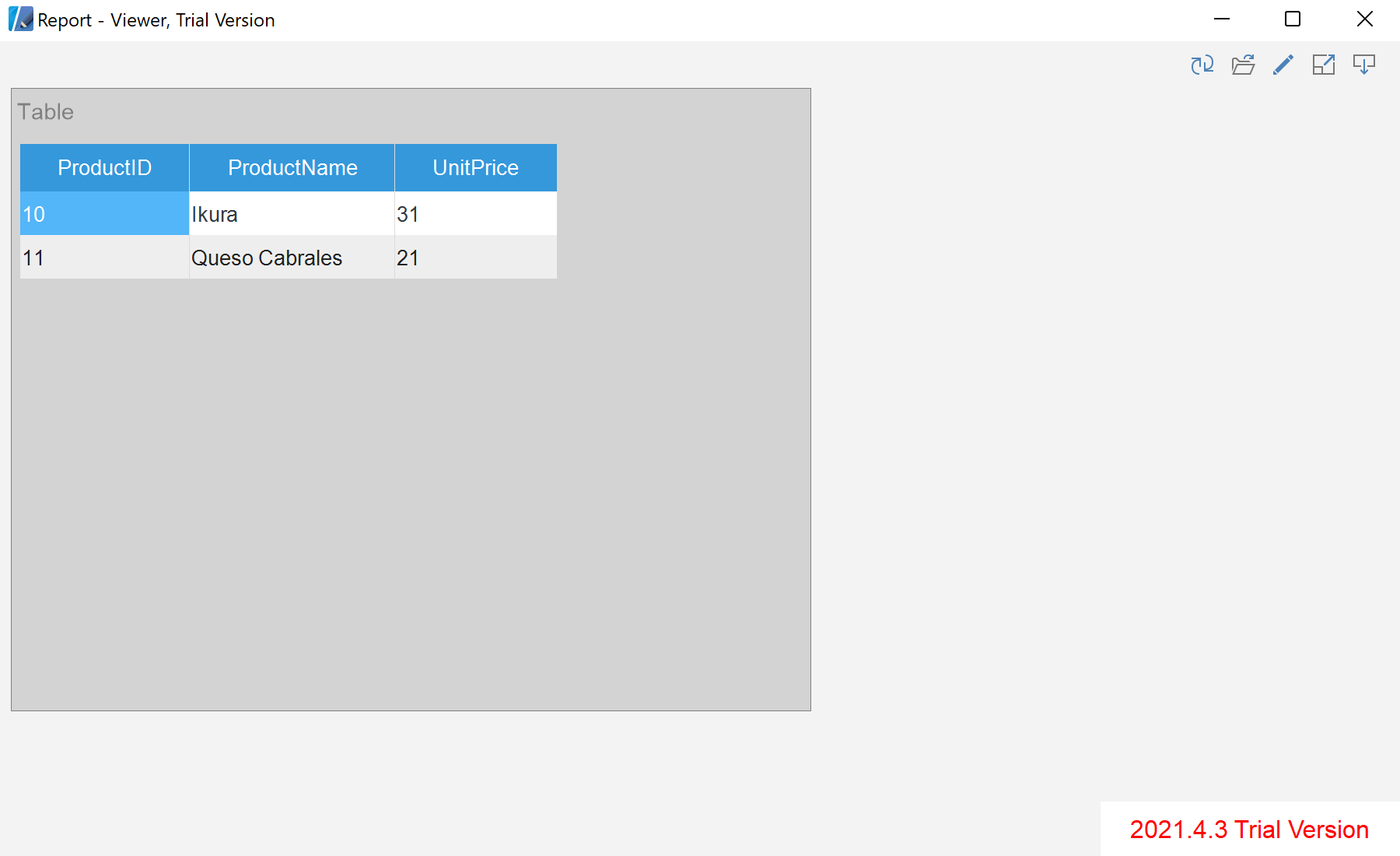
In the screenshot below you can see the result of the sample code:
Register data and add elements.
var report = StiReport.CreateNewDashboard();
var dashboard = report.Pages[0] as StiDashboard;

var data = new DataSet();
data.ReadXml("Data/Demo.xml");
report.RegData(data);
report.Dictionary.Synchronize();

var table = new StiTableElement { Left = 0, Top = 0, Width = 700, Height = 500, Name = "Example" };
table.Columns.Add(new StiDimensionColumn { Expression = "Products.ProductName" });
table.Columns.Add(new StiDimensionColumn { Expression = "Products.UnitPrice" });
table.DataFilters.Add(new StiDataFilterRule {
    Condition = StiDataFilterCondition.BeginningWith, Path = "Products.ProductID", Value = "1" });

dashboard.Components.Add(table);
report.Pages[0] as StiDashboard— the dashboard surface to add elements to.StiTableElementwithStiDimensionColumn— a table and the fields it displays.StiDataFilterRule— filters applied to the element's data.
How it works. Building the element tree in code is equivalent to designing it visually, so the dashboard renders identically to a template-based one.
In the screenshot below you can see the result of the sample code: